

It started with a tweet.
Someone on X posted that we should revive Teletext for the terminal. Totally serious. And the second I saw it, something in my brain lit up.
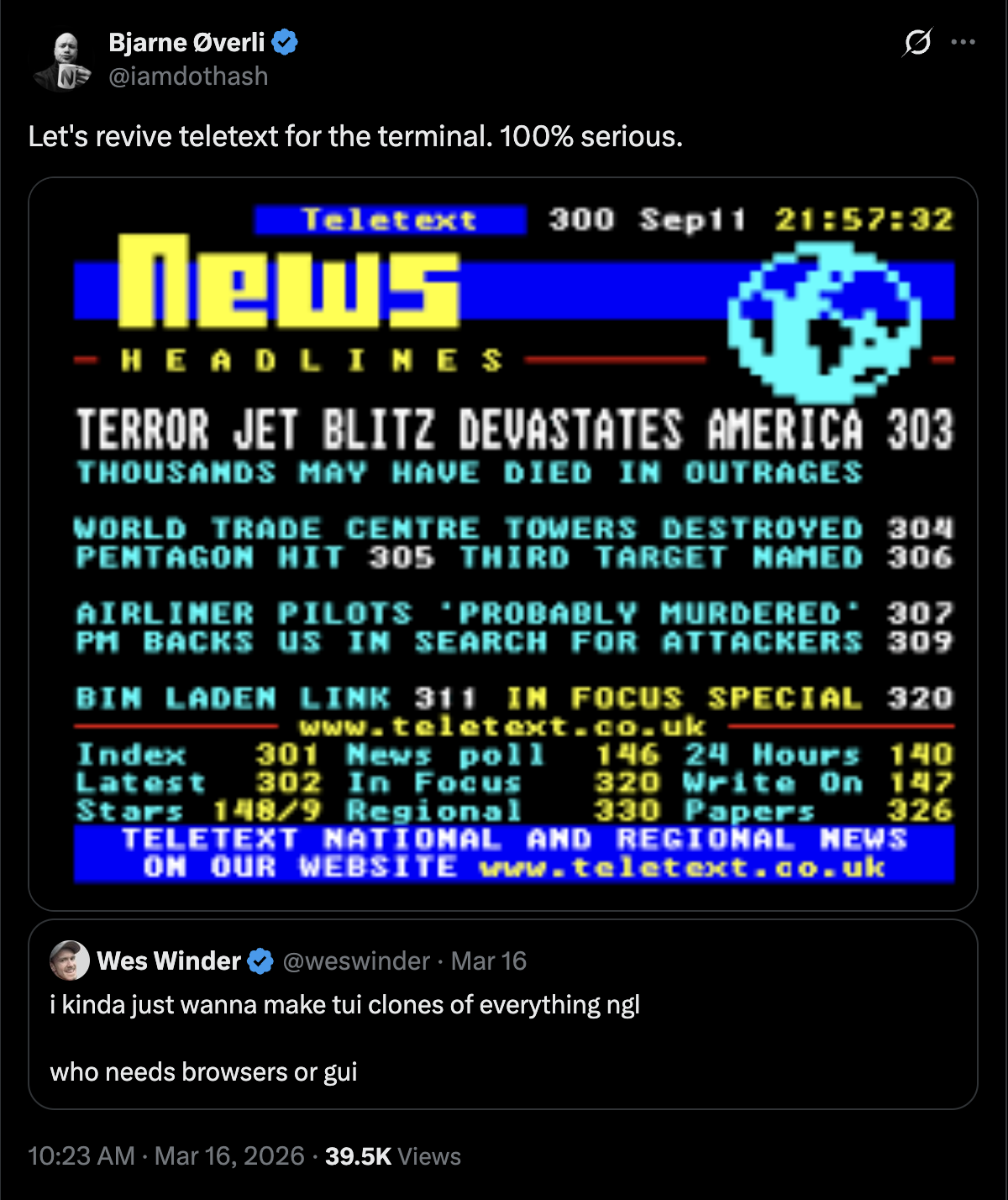
I started digging around online and found archives of real Teletext pages in binary packet stream form. Actual old broadcast data. Not screenshots. Not mockups. The real thing. And I immediately had that familiar builder reaction:
Wait a minute. Can I bring this back to life?
I remember Teletext from when I was young. I'm originally from the Netherlands, where it still has a weird kind of cultural staying power. And I've been on a retro kick for a while now anyway. I've made retro-style games, retro renderers, even a CRT shader I'm very happy with. So this felt like a natural extension of that obsession.
Old display technologies just hit different
There is something deeply satisfying about systems that did a lot with very little. Teletext is blocky, limited, awkward, and visually primitive by modern standards. And yet people managed to make some genuinely cool looking things with it. That combination of harsh constraints and unexpected expressiveness is catnip to me.
So I decided to try something.
I built a viewer.
And to my surprise, it came together ridiculously fast.
In just a few evening hours, I had something that could parse those old packet streams and display real Teletext pages. Seeing that work for the first time was one of those pure builder moments. Just a full-on:
Wow. Damn. I can actually do this.
And yes, part of the thrill was Teletext itself. But another huge part of it was realizing how different the world feels now with AI coding tools in the mix.
Because let's be honest: a project like this used to live in that category of ideas that sound cool but feel just annoying enough, obscure enough, and technical enough that most people would never even start. Parsing and rendering an old broadcast format is exactly the kind of thing that would have felt absurdly out of reach as a casual side quest not that long ago.
Now? I just went and did it.
That was the first jolt.
The second came right after
Once I had the viewer working, I realized archived pages were cool, but not exactly the most compelling demo for most people. Random legacy content is fun if you already care about Teletext. I needed something more immediate. Something with a point.
So I decided to make a Teletext version of my own website.
That part was actually pretty easy to automate. But then I ran into a more interesting problem. A Teletext website with no actual Teletext-style homepage is kind of lame. I didn't just want text dumped into a format. I wanted something that looked like it belonged there. A proper homepage. Big chunky graphics. Strong composition. The whole thing.
And that is the moment the project changed.
Because now I didn't just need a viewer anymore. I needed an editor.
Not a throwaway little utility. A real system that would let me create pages from scratch, edit them properly, and control the output in a way that felt true to the medium. Suddenly the whole thing went full circle. I could read real Teletext data, display it, edit it, and generate new pages of my own.
That was already cool.
But then, because apparently I have a hard time leaving well enough alone, I decided to go one step further and build bitmap-to-Teletext conversion too.
That meant I could import an image and have the system render it using Teletext graphic elements.
And that led to the single coolest moment in the whole project.
I made a Teletext homepage with my own face on it. My face, rendered in Teletext blocks. Alongside my logo. Inside this gloriously weird, blocky, retro information system that most people now think of as ancient television junk.
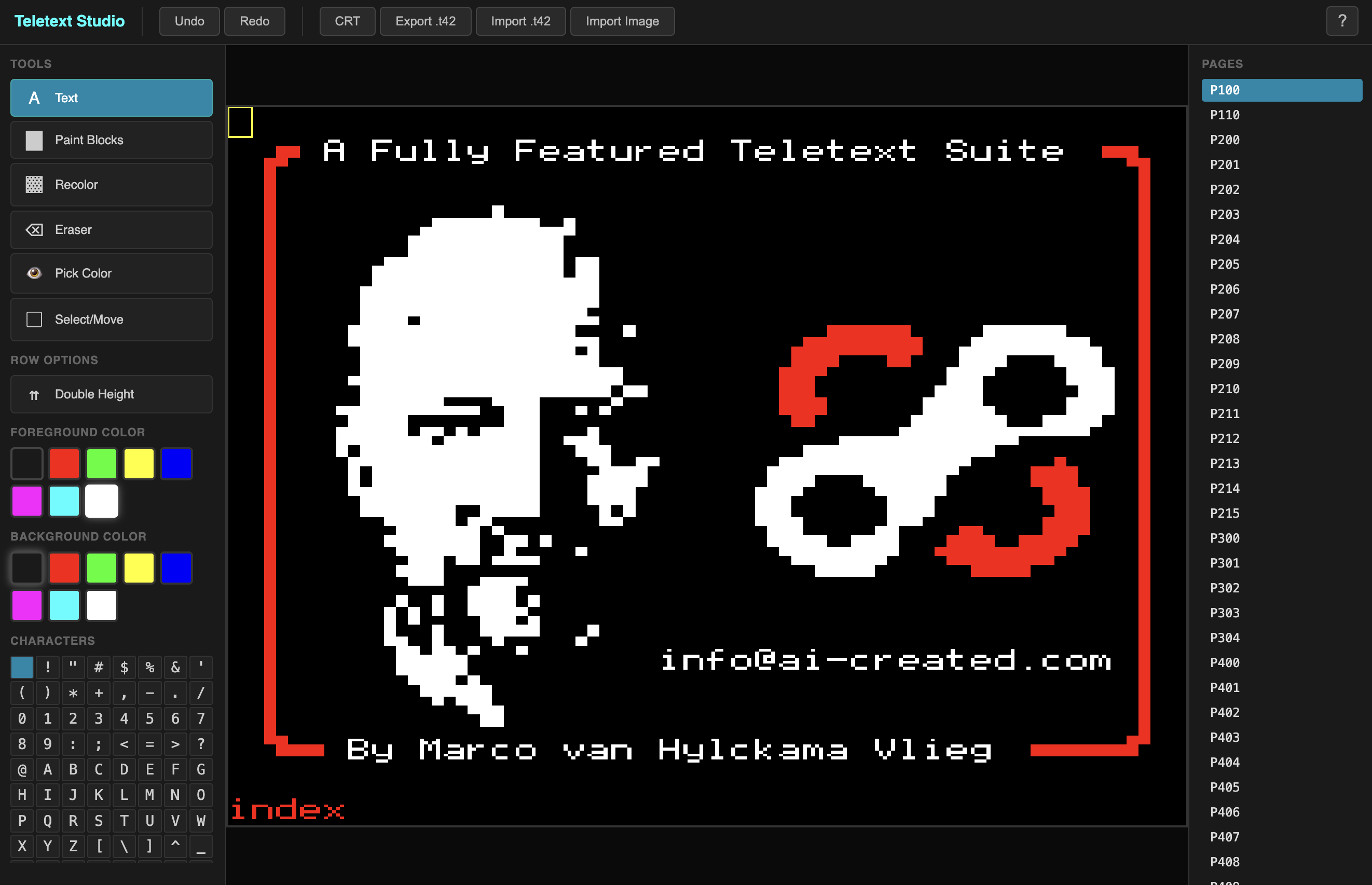
Seeing that on screen was another total shockwave moment.
Because at that point this thing had stopped being a fun parser demo. It had become a fully featured creative system.
And then I remembered the original tweet
It was not just about reviving Teletext in general.
It was about reviving it for the terminal.
At that point I thought: well, I've come this far. I may as well drive this all the way home.
So I tried to make it work inside an actual terminal window.
And unbelievably, it did.
I got it looking almost perfectly right too. Almost. The one thing I could not get to play nicely was double-height text. That turned out to be one of those infuriating edge cases where something is technically possible in principle, but starts interfering with other aspects of the rendering once you actually try to make it coexist with everything else. I may take another run at it later. But for now, that is the one concession.
Everything else works beautifully.
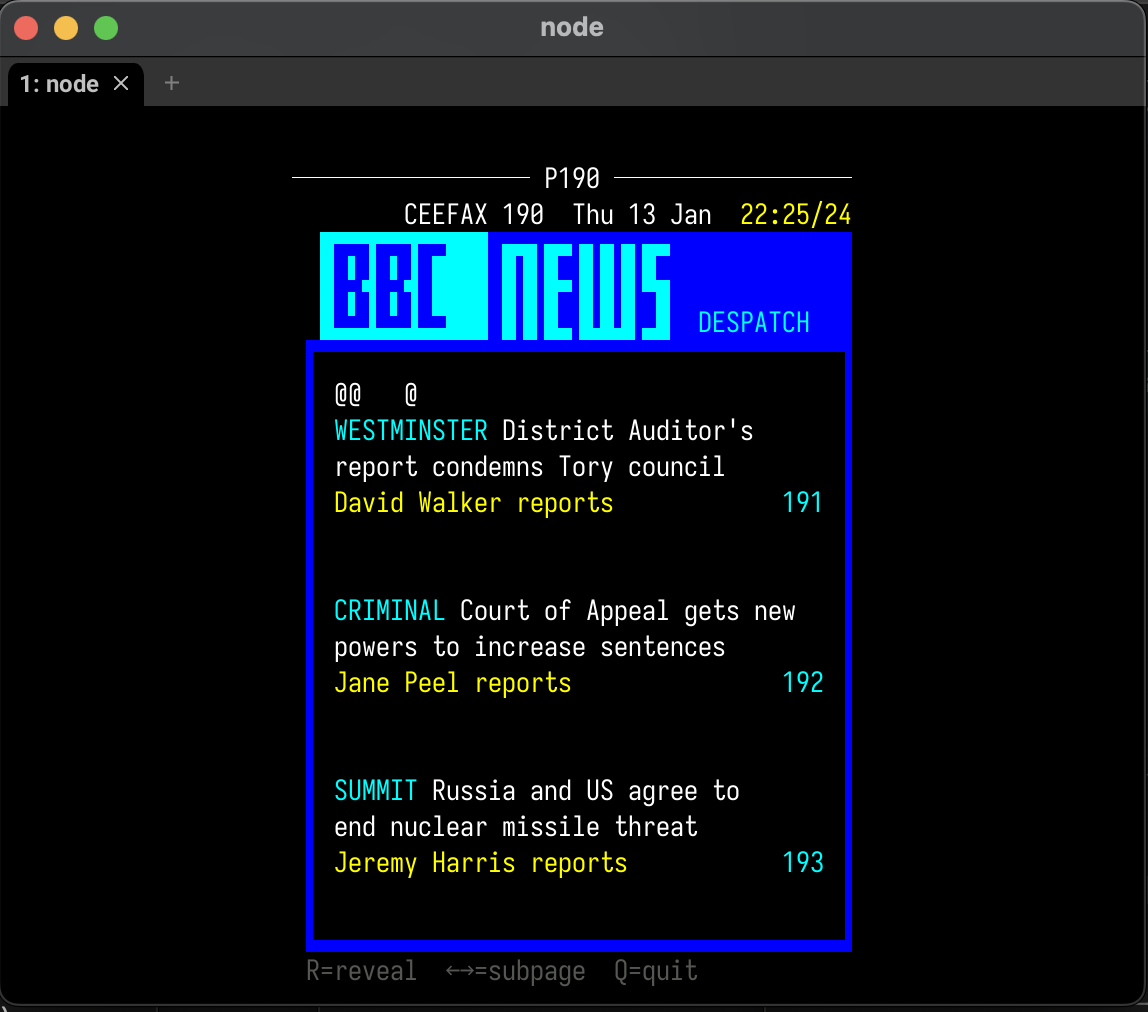
That detail matters, I think, because it keeps the story honest. This was not magic. It was not me typing "make Teletext terminal lol" and watching perfection fall out of the sky. It was still a real build. It still required judgment. It still required taste. It still required pushing through weirdness and deciding what was worth solving now versus later.
But what completely blew my mind was just how reachable the whole thing felt
That is the real story here.
Not that I made a Teletext thing.
Not even that I built a viewer, an editor, an importer, and a terminal version.
The real story is that building something like this no longer feels outlandish.
That is the shift.
That is the part I don't think we have fully absorbed yet.
We are now living in a moment where one person can go from "I saw a weird tweet" to "I built a full suite for parsing, displaying, editing, generating, and terminal-rendering an obscure binary media format" in basically no time at all.
That is insane.
And I mean that in the best possible way.
When I posted the project on X, people loved it. A lot of that was obviously nostalgia. You could almost hear people going: "Oh wow. Right. I remember this." It clearly hit a nerve. But I think part of the reaction was also that this thing was not just a tribute. It actually worked.
It wasn't some vague retro aesthetic mood board.
It was alive.
That, to me, is what makes this project feel like a real tour de force
Not because Teletext is the most important technology in the world. Obviously it isn't. But because it is such a beautifully strange proof point for what is possible now.
Two short evenings.
That is what really messed with my head.
Because after building this, I walked away with a feeling that is hard to shake: there is very little I cannot do now if I really set my mind to it.
And honestly?
That feels like the future.
Link to the project in action: teletext.ai-created.com
Link to source repo: github.com/TheMarco/teletext


