
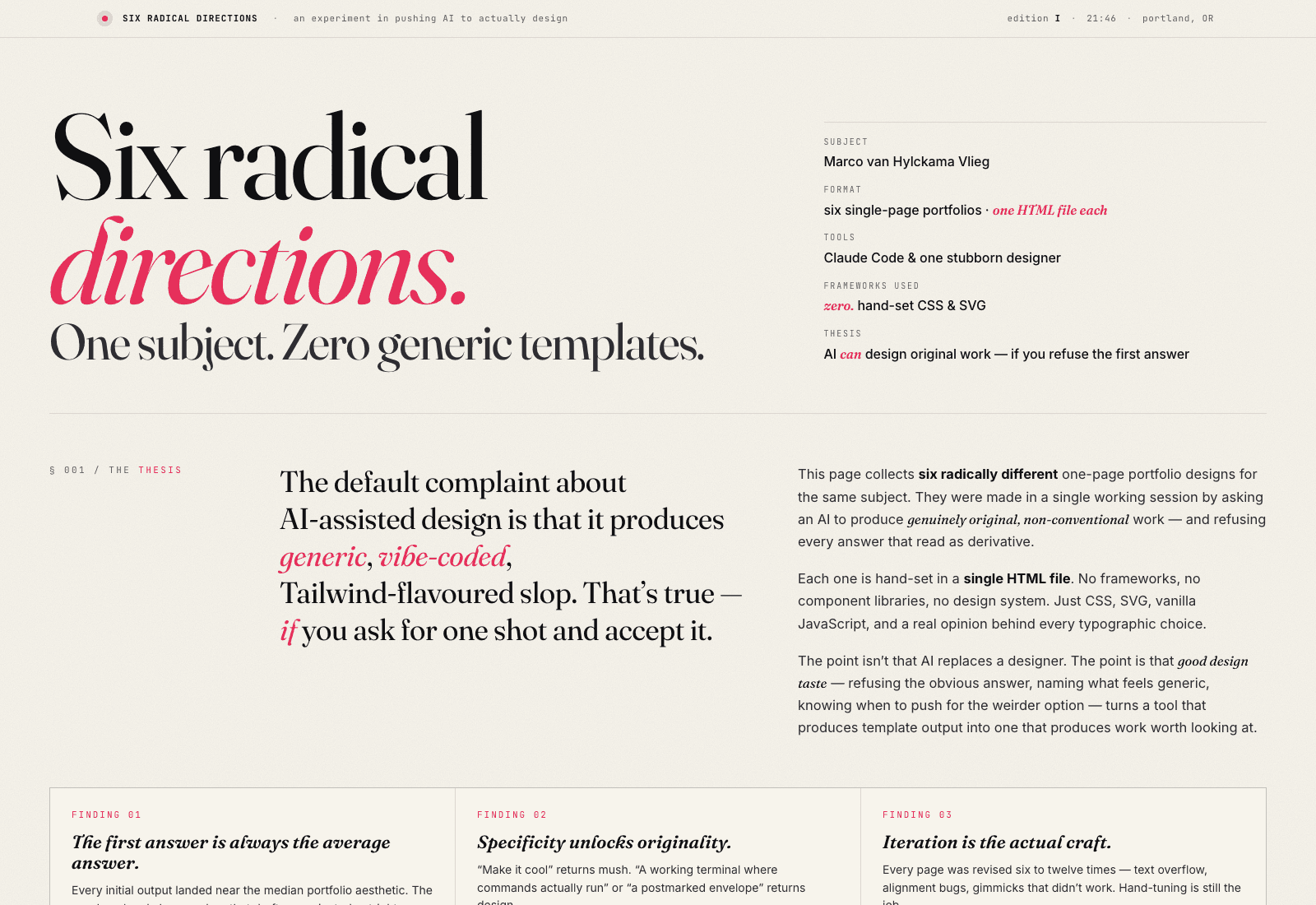
The most common take on AI design right now goes something like this: it all looks the same, it all reads as vibe-coded, it is Tailwind-flavoured slop with a soft gradient and a glass card and a hero headline in 72px Inter.
That take is correct.
It is also lazy.
Because it describes what AI produces when you ask for one thing, accept the first answer, and stop. It does not describe what AI produces when you actually push.
I spent a working session pushing. The output is a project I have been calling Seven Radical Directions: seven completely different one-page portfolios for the same person, me, each one a single self-contained HTML file. No frameworks. No component library. No design system. Just CSS, SVG, vanilla JavaScript, and a real opinion behind every typographic choice.
Then I built a showcase landing page that introduces the experiment and links to each of the seven directions. The whole thing functions as one piece of evidence against the "AI only produces slop" position.
What the seven directions actually are
The point of building seven, not one, was to prove range. To prove that "AI portfolio design" does not have to converge on the same gradient hero with the same three feature cards.
Here is what came out of the session:
- The Anthology. A printed magazine cover with a massive italic name set in Fraunces, running heads, a colophon, variable-font typography that reacts to the cursor.
- Marco/Shell. A real interactive terminal. You can type
help,ls,cat about.md,man marco,sudo hire-me. The portfolio is the shell session. - A Letter from Marco. A piece of physical correspondence rendered in HTML. Envelope, SVG postage stamps, a wax seal, postmark, polaroids on a contact sheet, an index card.
- Anthology, Vol. I. A vinyl record. Album cover, spinning disc with a tonearm that tracks, Side A as the career, Side B as the lab, liner notes, label closeup.
- Object MVHV-001. An astronomical observation. Telescope view, the career as a constellation chart, spectroscopic capabilities, orbital lab bodies.
- MVHV Transit. A Vignelli/Beck transit map. Six coloured lines, fifteen stations, project termini, line filtering, station tooltips.
- MVHV Arcana. A holographic tarot reading. Mouse-tracked rainbow foil on the hero card, a ten-card Celtic Cross spread that doubles as a CV, flip-to-read interpretations.
Print, code, mail, music, science, infographic, mystical. Same subject. Seven different framings. None of them look like the same person's portfolio twice.
The first answer is always the average answer
The most important thing I learned in this session is something I already half-knew but had never seen demonstrated this cleanly:
The first answer is always the average answer.
Every initial attempt landed near the median portfolio aesthetic. Gradients. Soft cards. A serif in the hero, a sans-serif everywhere else. A grid of project tiles. The same competent, forgettable surface you have seen a thousand times because it is the statistical centre of "modern portfolio website" in the training data.
That is not a Claude problem. That is a "you asked for the average and you got it" problem.
The good work started the moment I rejected the draft outright and said, in plain words, that the result was generic. Then I said it again on the next one. Then I asked for "a working terminal where commands actually run," not "a developer-style portfolio." Then I asked for "a postmarked envelope with stamps," not "a creative portfolio with personality."
Specificity unlocked originality. "Make it cool" returned mush. A concrete artefact, named in detail, returned design.
What the feedback actually sounded like
I keep the session quotes because they are the real artefact of how the work got made. The model did not write these. I did.
"Also, this entire design is still rather reminiscent of my website. Can you not make it more original?"
"Make it NOT look like the average vibe-coded website. We need this to be amazing and different."
"Now do one more. Yet another completely wild, different direction."
"The effect with the dots in the hero is cool but doesn't work right. It doesn't show where the cursor is and initially it doesn't load right at all."
"Click and drag rotates the entire module. The record looks weird."
"This is so insanely cool I want you to do another one."
That is the loop. Rejection, specificity, pressure, hand-tuning, and the occasional "this is the one, keep going." It is not very different from how you art-direct a junior designer who has good fundamentals and is one push away from doing something interesting.
The model is not the designer. The taste in the room is the designer. The model is the very fast pair of hands.
Iteration is the actual craft
Every page in the gallery was revised somewhere between six and twelve times. Text overflowing the layout. Letters colliding with their own kerning. Animations that looked impressive in description and weird in practice. The tarot spread initially flipped cards on click, which was fine but boring, until I asked for hover-flip and the page suddenly felt like a real reading.
There is no version of this work where you accept the first output and ship.
This is the part that gets erased in the discourse. People look at AI-assisted work, see that it was made with AI, and conclude that the AI made it. As if the prompt was the labour. As if "make me a portfolio in seven different styles" produced what is on screen.
It did not. Most of the time spent on this project was not prompting. It was reading the result, naming what was wrong with it in language that was precise enough to act on, and doing that again, and again, and again.
That is craft. It happens to involve a model. It is not done by the model.
The honest version of the AI-design critique
The honest version of "AI design all looks the same" is this:
AI design all looks the same when you let it. The default is the average, the average is the bland end of the median portfolio, and if you accept the average you will get the bland end of the median portfolio. That is a true statement about a real failure mode.
It is not a true statement about the tool.
A capable, opinionated designer using AI is not producing the same gradient hero. They are producing things that did not exist before they sat down to make them. A terminal that runs. An envelope with a real postmark. A transit map of a twenty-year career. A spinning record.
The "AI is bland" position requires you to believe that the model is the designer. If you actually do the work, you know it is not. You are.
What I want this project to argue
Seven Radical Directions is not a job application. I am not looking. It is also not a flex. The work is intentionally varied and intentionally weird, which is exactly the wrong move if your goal is to be hireable through pattern-matching.
What it is, is evidence.
Evidence that the ceiling of AI-assisted design is much higher than the discourse pretends. Evidence that when a designer with taste pushes the model past the average, the output stops being slop and starts being design. Evidence that the bottleneck is not the model. It is the willingness to say "no, do it again, weirder."
If you have been telling yourself that AI design is dead, or that it all looks the same, or that there is no point trying, I would like to gently invite you to push harder. Not to praise the first answer. Not to accept the gradient hero. Not to ship the default.
There is a lot more in there if you are willing to dig for it.
The whole project lives at onepager-beige.vercel.app. Seven HTML files, one showcase, hand-set CSS, zero frameworks, and a stubborn designer who refused to accept the first answer.
That is the experiment. Try it on something of your own.


