
I designed and built an evidence-first AI application coach that turns a candidate’s real experience into stronger, traceable job applications.
TL;DR
- Problem: A résumé rarely captures the full reality of someone’s career. Generic AI tools make matters worse when they invent details, exaggerate weak evidence, or produce interchangeable application materials.
- Product thesis: Establish what is true before generating anything.
- My role: Solo product designer and engineer. I defined the product, designed the experience, built the application, integrated the AI systems, secured it, tested it, and shipped it.
- What shipped: A free production application that analyzes real opportunities, builds a structured evidence base, interviews candidates about missing context, and produces tailored résumés, cover letters, and application answers.
- Technical foundation: Next.js, Postgres, Prisma, structured AI outputs, background job processing, encrypted credential storage, and support for OpenAI, Anthropic, and Google Gemini.
The problem
People are usually more qualified than their résumés make them look.
A résumé is a compressed representation of a much larger career. It leaves out context, supporting evidence, side projects, leadership stories, technical work, writing, recommendations, and details that may be highly relevant to a particular opportunity.
Most application tools work from that incomplete document and immediately start generating. The result may sound polished, but it is often generic, poorly matched to the job, or built on claims the candidate cannot comfortably defend.
I wanted to build a system that approached the problem differently.
Human, Actually starts by building a grounded picture of the candidate. It gathers evidence, identifies gaps, asks focused questions, and only then helps create application materials.
How it works
Every application begins as a case built around a real opportunity.
The candidate adds the job description, résumé, portfolio, website, GitHub profile, notes, writing samples, recommendations, or any other source that helps demonstrate what they have actually done.
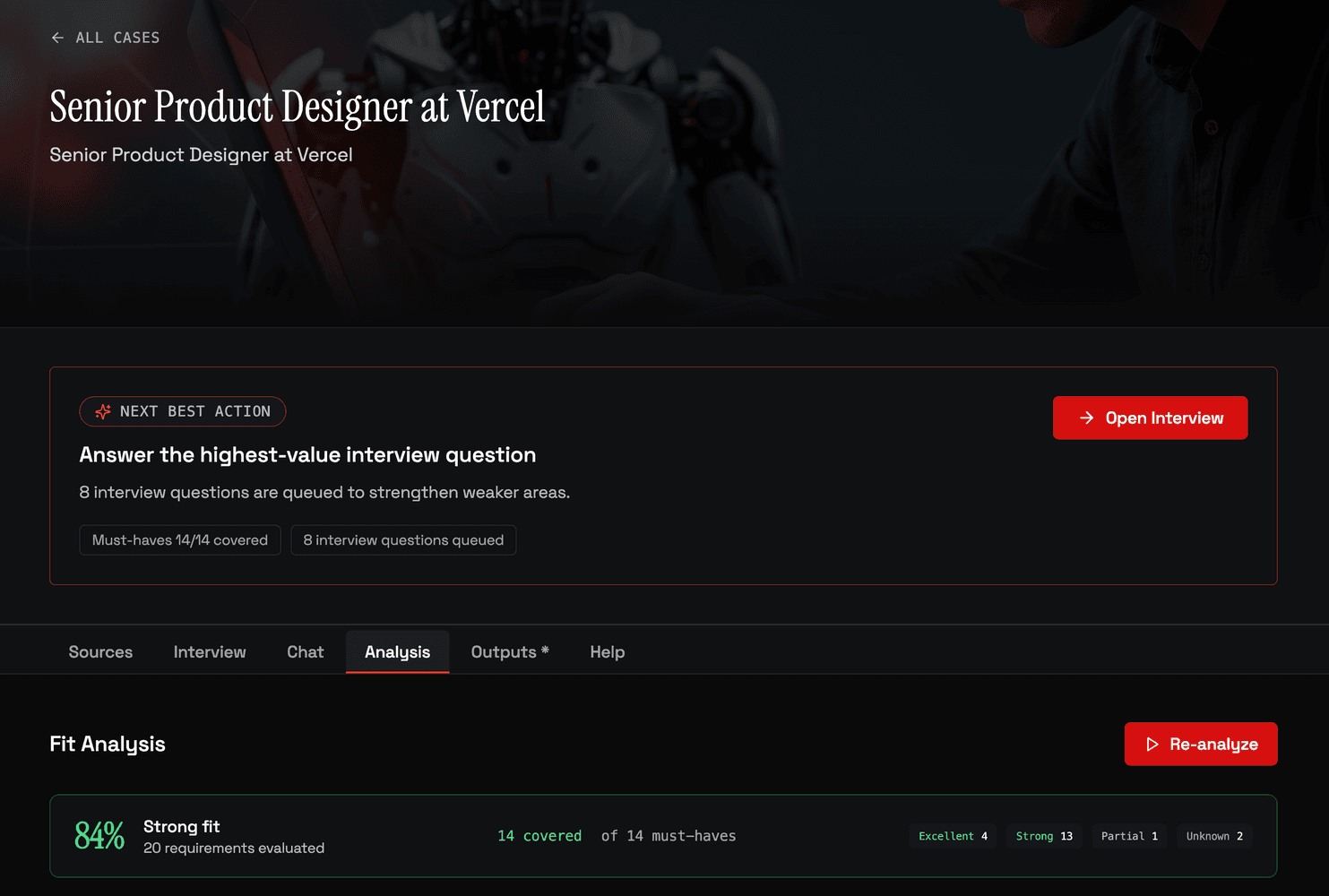
Human, Actually processes those sources into structured evidence. It compares that evidence against the requirements of the role and identifies where the match is strong, partial, missing, or unsupported.
That analysis becomes the foundation for everything that follows.
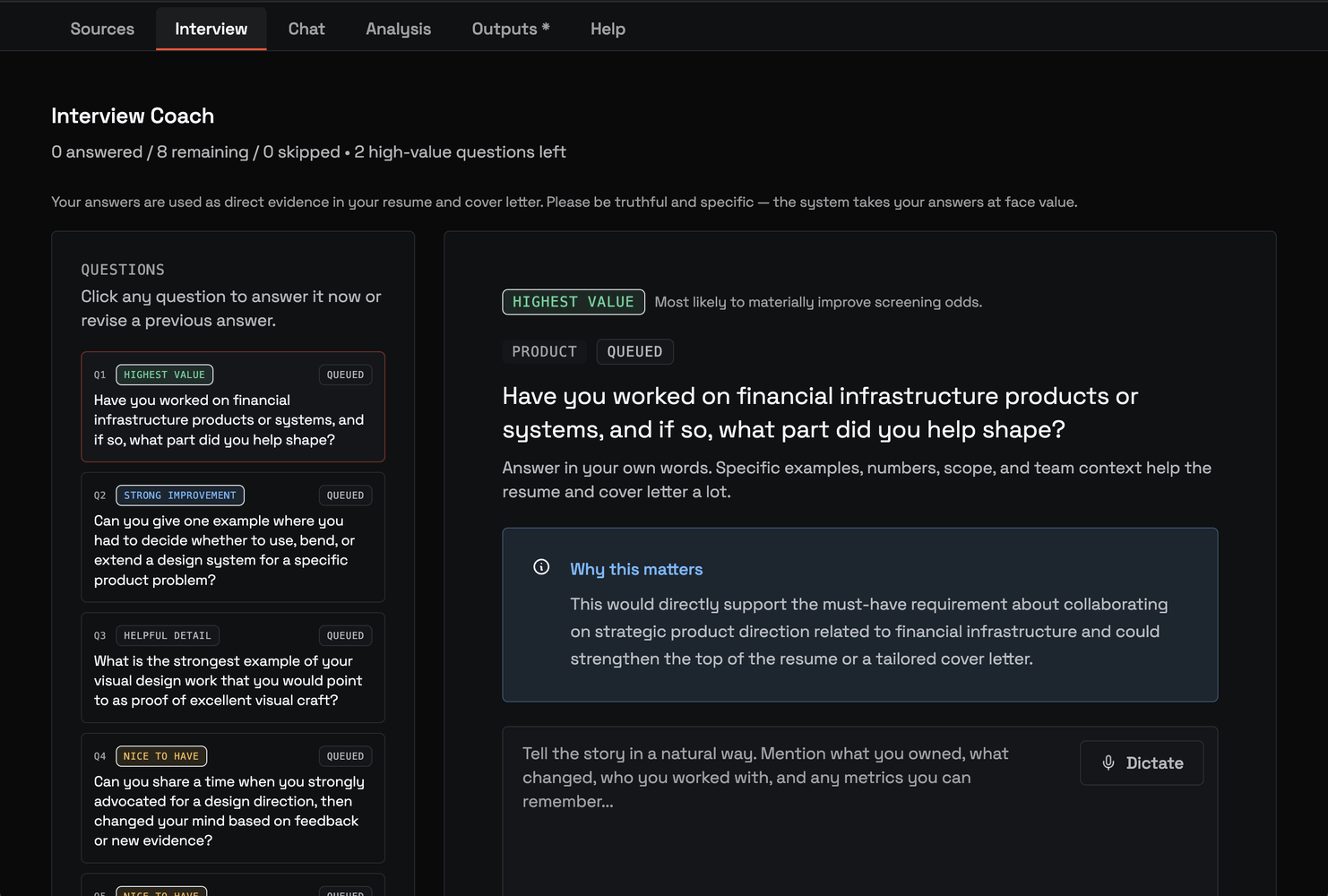
The system can then ask targeted interview questions to uncover relevant experience that never made it into the original résumé. Candidates can also talk naturally about their work through a separate chat experience. Useful facts from those conversations can be reviewed and added to the evidence base.
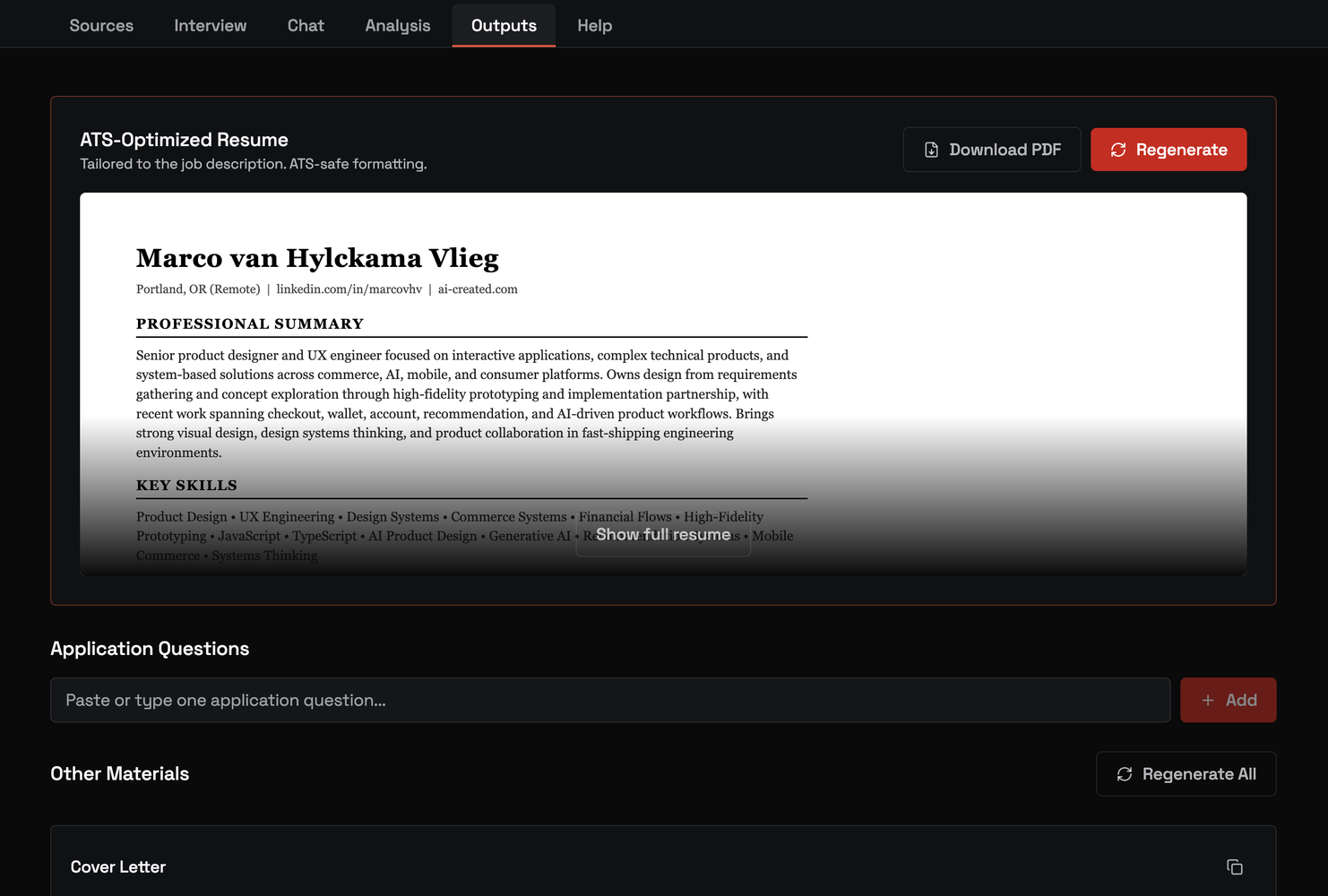
Once the evidence is strong enough, Human, Actually generates application materials tailored to the specific opportunity.
The core product decisions
Evidence before generation
Every important claim should connect to something real.
Human, Actually tracks where information came from and distinguishes between direct evidence, reasonable inference, and unsupported claims. The system is designed to strengthen a candidate’s presentation without manufacturing a different person.
Ask when information is missing
A weak match does not always mean the candidate lacks the experience. Sometimes the evidence simply has not been captured.
The interview flow asks focused questions based on the actual gaps found during analysis. Those answers feed back into the case and improve the quality of later outputs.
Make fit visible
The product shows how the candidate matches the role instead of hiding the analysis behind a single score.
Requirements are evaluated individually so candidates can see where they are strong, where the match is partial, and where applying may not be worth the effort.
Treat each artifact as a different product problem
Résumés, cover letters, and application questions serve different purposes.
The résumé workflow plans and ranks bullets, checks requirement coverage, and runs quality assurance for repetition, weak language, unsupported claims, missing metrics, and unnecessary age-revealing cues.
Cover letters use a separate workflow focused on motivation, narrative, tone, and voice. Candidates can steer the result toward direct, warm, concise, or technical language and provide writing samples for light personalization.
Application questions are handled individually so each answer can be reviewed, edited, regenerated, and saved without rebuilding the entire application.
Always show the next useful action
A complex workflow can quickly become overwhelming.
Human, Actually looks at the current state of a case and recommends the next useful step, such as adding a missing source, answering an important question, refreshing the analysis, or reviewing an output.
The goal is to keep candidates moving without forcing them to understand the entire system at once.
What shipped
Human, Actually is a working application, not a presentation or static prototype.
The production system includes:
- Source ingestion from résumés, websites, portfolios, GitHub, notes, and writing samples
- Structured evidence extraction and provenance
- Job requirement analysis and fit assessment
- Adaptive interview questions based on evidence gaps
- Natural-language chat that can surface additional confirmed facts
- ATS-aware résumé generation with automated quality checks
- Separate cover-letter generation with tone controls
- Per-question application assistance
- Public-presence auditing across recruiter-visible profiles
- Background processing for long-running AI operations
- Encrypted storage for user-owned provider credentials
- Support for OpenAI, Anthropic, and Google Gemini
- A shared, versioned design system used across the full product
The application is built with Next.js, Postgres, Prisma, structured model outputs, and a job architecture designed to handle AI operations that cannot reliably finish inside a single request.
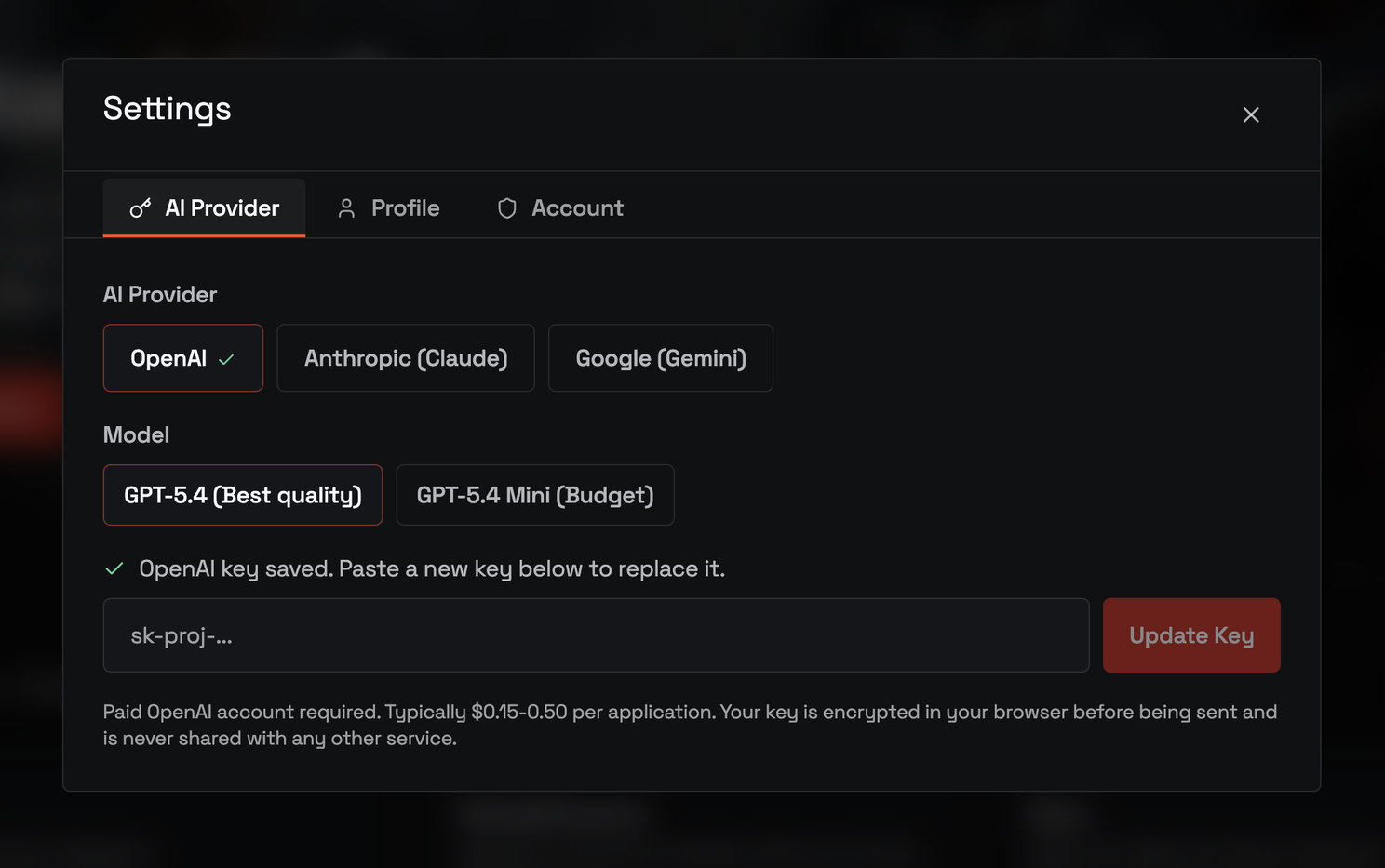
Users bring their own AI provider key, which keeps the application free while allowing them to choose the model they want to use.
My role
I owned the product from initial thesis through production.
That included product strategy, interaction design, information architecture, visual design, the evidence model, AI workflow design, technical architecture, implementation, security, debugging, deployment, and iteration.
The project required both product judgment and engineering execution. The difficult part was not generating text. It was designing a system that could handle incomplete evidence, uncertain matches, long-running operations, multiple model providers, sensitive credentials, and outputs that people may use in consequential real-world situations.
Adam Cobb and Eli Yelluas also helped with penetration testing and security recommendations.
Why it matters
Human, Actually demonstrates what I mean by AI-native product development.
AI is part of the product’s reasoning model, but the experience is built around the human decisions surrounding it: what evidence to trust, when to ask a question, how to communicate uncertainty, what should remain editable, and how to prevent confident generation from becoming confident fabrication.
It also represents the way I work. I can take an ambiguous problem, define the product model, design the interaction, build the system, and continue refining it until it becomes usable software.
A job application is ultimately a set of claims about a real person. Human, Actually is designed to keep that person, and the evidence behind those claims, visible throughout the process.
That is why I called it Human, Actually.