
At Kohl’s, I replaced an overloaded mini-cart interaction with a focused confirmation overlay, then partnered with product and engineering to prove the decision through A/B testing.
At a glance
Challenge: The mini-cart tried to confirm an add-to-bag action, preview the cart, surface offers, show rewards, and direct the shopper’s next step at the same time.
My role: Senior Product Designer. I identified the interaction problem, owned the design direction, and partnered with product and engineering to implement and test the alternative.
Product decision: Replace the mini-cart with a focused confirmation overlay that clearly showed what was added and offered two next steps.
Validation: We tested the new experience against the existing mini-cart using Adobe Target.
Outcome: The simplified experience generated $25 million in annualized incremental revenue during A/B testing.
The moment after “Add to Bag” was doing too much
Adding an item to a cart is one of the clearest signals of purchase intent in ecommerce. The interface that follows should reassure the shopper that the action worked and help them continue.
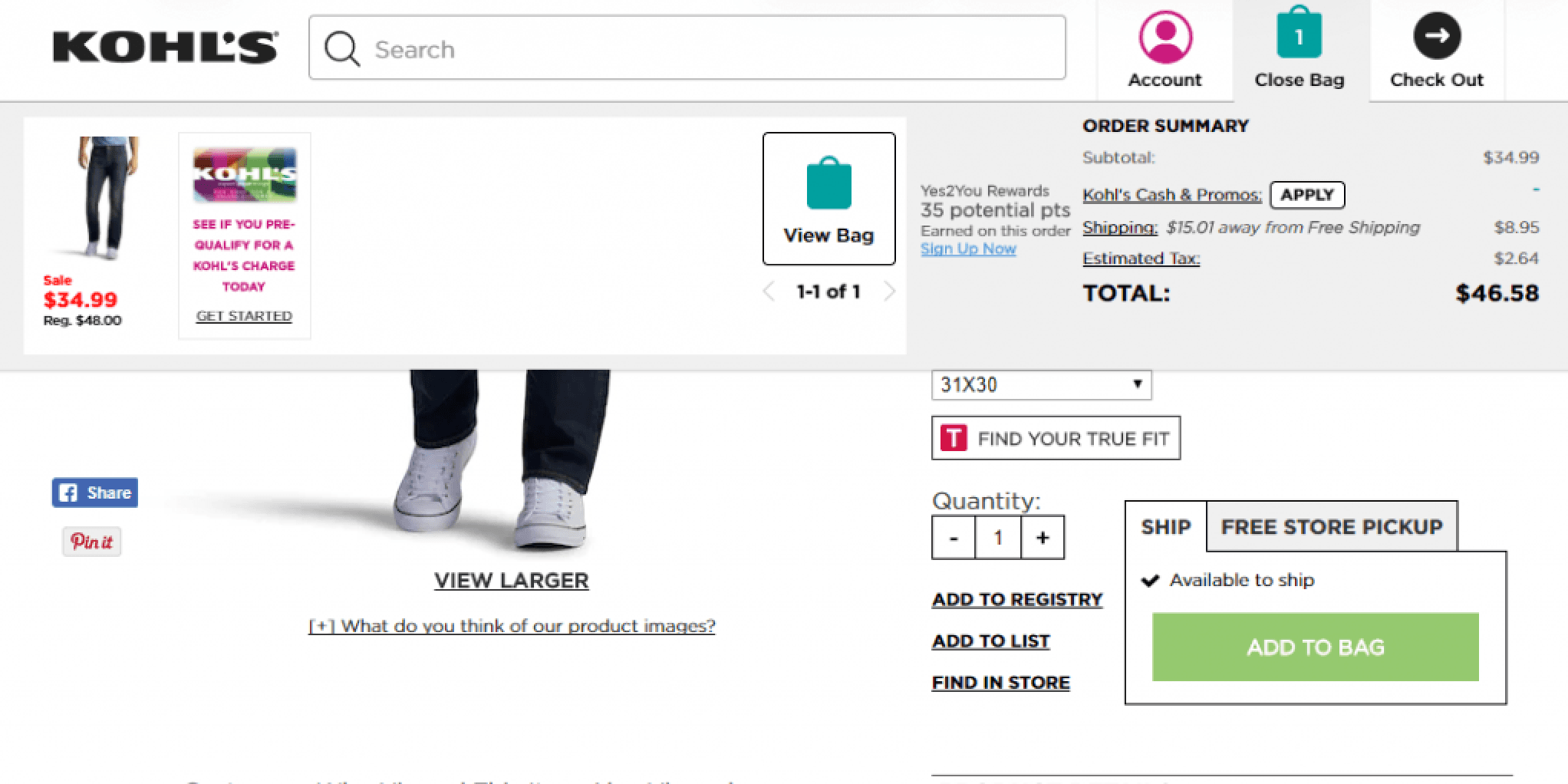
At Kohl’s, that moment triggered a mini-cart containing several competing layers of information. It confirmed the action, displayed cart contents, surfaced promotions and rewards, exposed account context, and presented navigation choices.
Each addition may have made sense on its own. Together, they turned a simple confirmation into an interruption. The shopper had just made progress toward a purchase, but the interface suddenly demanded that they interpret a dense collection of messages and options.
I reframed the interaction around the two decisions that mattered:
- Confirm that the item was successfully added.
- Let the shopper continue browsing or proceed to checkout.
A focused confirmation instead of a miniature cart
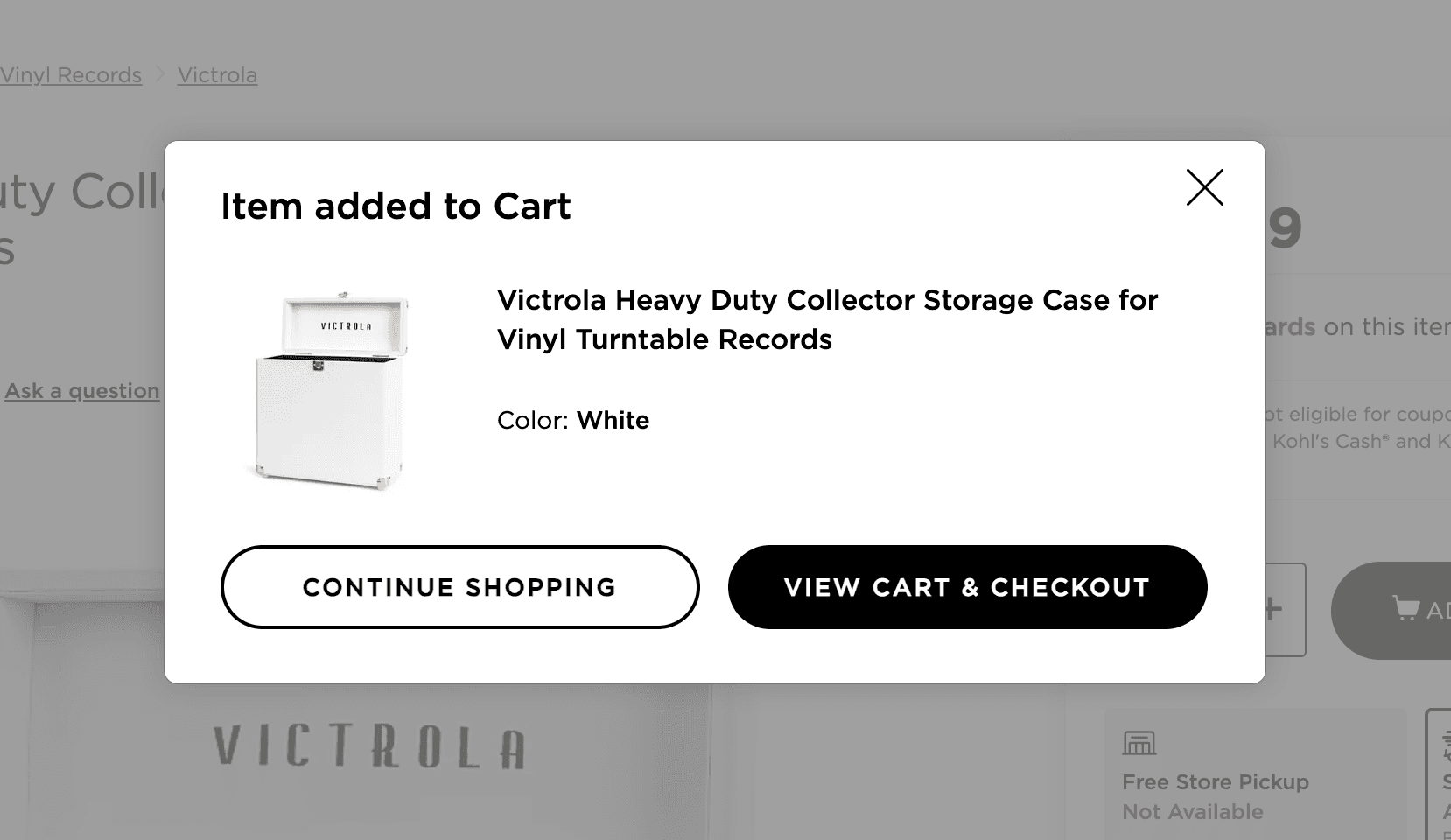
I proposed replacing the mini-cart with a modal confirmation overlay. The new experience clearly stated that the item had been added, showed the relevant product and variant information, and presented two obvious actions:
- Continue shopping
- View cart and checkout
This was a structural product decision, not simply a visual cleanup. Promotions, rewards messaging, account information, and unrelated merchandising were removed from this moment so the interaction could perform its primary job without competition.
The before-and-after difference was substantial:
| Existing mini-cart | Focused confirmation |
|---|---|
| Confirmation competed with several modules | Confirmation became the dominant message |
| The shopper had to interpret a miniature cart | The added product and variant were immediately visible |
| Offers, rewards, and account content added noise | Unrelated content was removed |
| Several possible paths competed for attention | Two clear next steps remained |
Turning product judgment into a testable hypothesis
The design was intentionally opinionated, but the decision did not depend on opinion alone. I worked with product and engineering to turn it into a testable experience and launch it against the existing mini-cart using Adobe Target.
Our hypothesis was straightforward: reducing competing messages and making the next step explicit would help more shoppers continue toward purchase.
Testing the complete interaction mattered. A static design could demonstrate the hierarchy, but only a working variant could reveal whether the simpler experience changed customer behavior.
The result
The simplified confirmation experience produced a significant conversion lift. When A/B tested against the existing mini-cart, it generated $25 million in annualized incremental revenue.
The scale of the result was striking because the interface change was relatively contained. We did not add a new sales channel or major feature. We improved one high-intent moment by giving it a clearer purpose.
The outcome showed that accumulated interface complexity had been creating measurable friction. Removing that friction helped more shoppers keep moving through the purchase journey.
Protecting the decision after the test
After the simpler experience won, we explored whether additional content such as upsells could improve it further. Those additions did not produce a meaningful improvement.
That follow-up work helped clarify why the original test succeeded. The focused version worked because it resisted the pressure to make one interaction serve every possible business goal. Additional content weakened the hierarchy without adding enough value.
The strongest version remained the one that confirmed the action and helped the shopper choose what to do next.
What I contributed
- Identified friction in a high-intent ecommerce interaction
- Diagnosed how the mini-cart had drifted beyond its original purpose
- Reframed the experience around confirmation and next-step decision-making
- Designed the simplified interaction model and visual hierarchy
- Partnered with product and engineering to implement the test
- Validated the direction through Adobe Target experimentation
- Helped preserve the clarity of the winning experience during follow-up exploration
Why this work matters
Product design in a mature organization often involves deciding which requirements genuinely belong in an interaction and which have accumulated there over time.
This project required a clear product judgment, close collaboration with product and engineering, and the discipline to test the decision against real customer behavior. The result was a simpler experience for shoppers and $25 million in annualized incremental revenue for the business.